I Exercised My Whole Life —and Still Developed Osteopenia
What my first DEXA scan taught me about women’s bones, menopause, and healthy aging
I have been exercising regularly since I was 15
What my first DEXA scan taught me about women’s bones, I’ve taught Pilates for 20 years and taught aerobics for ten years before that. I’ve moved, strengthened, stretched, walked, danced and generally tried to take pretty good care of myself.
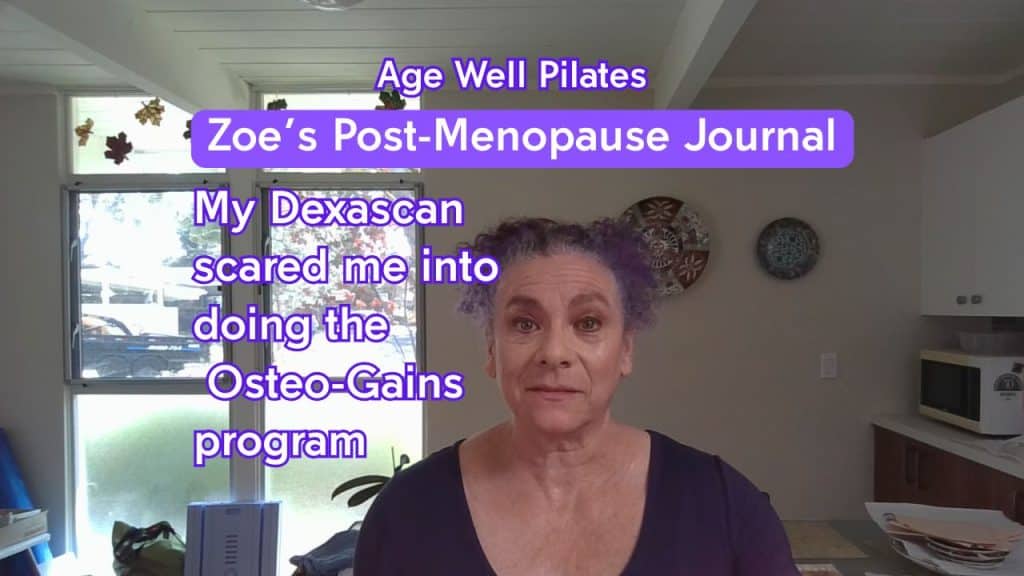
So, when my first DEXA scan showed slight osteopenia in my lumbar spine, I was surprised.
I thought I was doing everything right, taking calcium, vitamin D, eating protein every meal. Etc.
And that result sent me down a rabbit hole.
Not a scary rabbit hole.
A “Wait a minute…what else do I need to know?” rabbit hole.
And what I learned changed the way I think about menopause, and healthy aging.
What My Doctor Said About My Bone Density…
My doctor didn’t have much to say about the result at that point.
His advice was essentially to keep doing what I was doing and monitor the situation unless my health changed—for example, if I experienced a fracture or another significant risk factor.
That made sense from a medical-management perspective according to old school thought.
My doctor means well. But ever since the Women’s Health Initiative findings on HRT were miss reported medicine has closed the door on exploring women’s health in general.
Frankly, medicine is about 20 years behind in women’s health issues.
I couldn’t help thinking:
Do I really want to wait until I break something before I start taking my bone health seriously?
I didn’t.
I wanted to understand what I could do now.
And one of the first things I realized was that my idea of exercise needed to expand.
Pilates Is Wonderful. But bones Need heavier Resistance and Impact Too
This was a big realization for me.
Now, I have had elderly students gain bone density from Pilates.
Pilates is considered a weight bearing type of exercise. But it obviously wasn’t enough for me.
I’ve spent decades exercising, but I hadn’t been doing the kind of progressive resistance training that specifically challenges the bones with heavier loads.
The Bone Health & Osteoporosis Foundation recommends both
weight-bearing exercise and muscle-strengthening/resistance exercise for bone health.
Resistance training can include free weights and weight machines, while weight-bearing exercise includes activities where you’re working against gravity while upright. (Bone Health & Osteoporosis Foundation)
So, I changed my routine.
I’ve added three additional strength workouts each week using:
Heavy dumbbells
Barbells
Weight machines
This isn’t about suddenly becoming a bodybuilder.
It’s about giving my muscles and bones a reason to stay strong.
And there’s an important distinction here: the appropriate amount and type of loading depends on your individual bone health.
Someone with osteoporosis, a previous vertebral fracture, or a high fracture risk may need modifications and professional guidance before starting heavy or high-impact exercise. (Bone Health & Osteoporosis Foundation)
I Also Started Learning About Impact Exercise
The second thing I discovered was that strength isn’t the only stimulus bones respond to.
Weight-bearing and impact activities can also be important for bone health.
According to Dr. Vonda Wright walking and even running may not be enough to stimulate bone density improvement.
That’s what led me to Osteo Gains, an evidence-based exercise app that incorporates impact exercises such as jumping.
This was developed by a doctor who specializes in bone health for women, and she conducted a year long study that showed bone density improvement.
It’s challenging, it’s fun, and it definitely gets me sweating. And there are modifications for different fitness levels.
But this is another area where “more” isn’t necessarily better.
If you have osteopenia or osteoporosis, particularly if you have a history of fracture, impact exercise should be appropriate for your individual situation. High-impact exercise isn’t appropriate for everyone. (Bone Health & Osteoporosis Foundation).
That’s one reason I think working with someone who understands bone health can be so valuable. And also why Pilates on the reformer, Pilates jump board, Wunda Chair and Pilates wall unit is a great starting point if you have not exercised much in the past. Pilates on the equipment can be enough to start stimulating bone density increase as I have found with female students in their 60s and 70s. I have had 3 of my students reverse osteopenia with Pilates alone.
I’m Trying Something Else, Too
I also purchased an evidence-based OsteoBoost vibration belt.
It’s an expensive experiment, and I’m trying it because I want to be proactive about my bone health.
But I want to make something very clear:
I’m not presenting this as a proven solution for everyone.
I’m sharing what I’m doing and why I’m doing it.
There is a huge difference between:
“This is something I’m trying.”
and
“This will prevent osteoporosis.”
I’m interested in evidence, but I’m also willing to experiment responsibly with new evidence based techniques.
Then I Started Asking a Bigger Question
My bone scan also made me think about something much bigger:
Why are women’s healthy-aging strategies so often modeled around men?
This question actually started for me when I began looking into longevity science.
I became fascinated by the work being done around extending health-span and preserving muscle, metabolism and physical function.
But I kept thinking:
Where is the equivalent conversation about women’s biology?
Because women don’t age exactly the same way men do.
And menopause is a major biological transition.
Menopause Isn’t Just the Day Your Period Stops
One thing that gets confusing is the terminology.
Technically, It really should be renamed something like ovary death or hormone failure.
Menopause is one date on the calendar: it is simply the day that you’ve gone 12 consecutive months without a menstrual period.
The years leading up to it are called perimenopause, and the years afterward are postmenopause. (National Institute on Aging)
But culturally, we often talk about “menopause” as though it’s a short period of a year or two with hot flashes and night sweats. We are taught to think that after that transition period of a year or two everything just goes back to normal.
Yes the transitional phase ends, hot flashes might end but a bunch of other systems in the body are being effected by lack of hormonal support and this lasts until you die.
The biology is more complicated.
During the menopausal transition, ovarian hormone production changes substantially, and declining estrogen, and progesterone is associated with changes in bone density, body composition, sleep and other aspects of health. (Kelly Casperson)
And the bone connection is particularly important because bone and muscle health are related to dementia risk. Dr. Vonda Wright is an orthopedic surgeon and expert on bone health. Learn more from her here.
Estrogen and Your Bones
One of the things I wish more women understood is that estrogen, progesterone (and to some extent testosterone in women) isn’t just about reproductive health.
These three hormones play an important role in maintaining bone. And in perimenopause when bone loss begins we may not even feel it happening.
Before and after menopause, women can lose bone mass quickly for several years, after which the rate of loss generally slows but can continue.
That means the changes happening around menopause deserve our attention.
Not panic.
Attention.
Because there are things we can do.
*Strength training.
*Weight-bearing exercise.
*Balance training for fall prevention.
*Adequate nutrition and supplementation as needed.
*Monitoring bone density early. Dexascans are fairly inexpensive and Dr. Vonda Wright suggests starting in your 30s with a baseline and then monitoring bone density every year or two after that.
*And, for those who choose Bio-identical HRT can play a big part in protecting against Musculoskeletal Syndrome of Menopause.
What About Hormone Therapy?
This is where I think the conversation gets especially interesting—and where we need to look at this on a case by case basis with a menopause expert.
I personally became much more interested in menopause hormone therapy after learning more about bone health and the physiological changes that happen during menopause.
And there is good evidence that systemic hormone therapy can help prevent the bone loss that occurs early in menopause. It is an established treatment option for appropriate women. (Mary Claire Haver Menopause Specialist )
But hormone therapy isn’t right for everyone, and the benefits and risks depend on factors including age, timing, medical history, whether someone has a uterus, the type of hormone therapy, the dose and route of administration. (ACOG)
That’s why I don’t think this conversation should be:
“Everyone should take hormones.”
But
“Women should understand their options and have an informed conversation with a knowledgeable healthcare professional.”
That’s a very different thing.
I’m Particularly Interested in the “Healthy Aging” Conversation
One of the reasons I’ve become so interested in women’s longevity is that I don’t want our health strategy to begin only after something goes wrong.
I don’t want to wait for a fracture to discover that my bones needed more attention.
I don’t want to wait until I’m significantly weaker to start strength training.
And I don’t want to think about aging as something that simply happens to us.
I’d rather understand what’s happening in my body and ask:
What can I do about it?
That is the philosophy behind Age Well Pilates.
What I’m Doing Now
For me, that currently means:
Strength training
Three additional gym sessions per week focused on progressive resistance.
Impact exercise
Adding appropriate impact work to stimulate bone-loading.
Pilates
Continuing Pilates for strength, mobility, balance, posture and body awareness.
Nutrition
Paying attention to adequate nutrition and the nutrients important for bone health. Adding more ,unbreakable bone supplement with calcium and fortebone peptides, and Vitamin D, Creatine, Omega 3 fatty acid supplementation.
Monitoring
Keeping an eye on my bone density rather than waiting for a fracture to tell me something has changed.
Learning
Continuing to learn about menopause, hormones, muscle, bone and longevity.
And I’m not claiming that this is the prescription for every woman. It’s simply the approach I’m taking after looking at my own health and deciding that I want to be proactive.
The Resources That Started My Rabbit Hole
A few of the people and resources that have helped me learn more:
Lisa Moore / Brick House Bones
Lisa Moore’s work focuses on exercise and bone health, and her recommendations helped me think differently about resistance training.
Brick House Bones
Osteo Gains
An exercise app focused on evidence-based impact training for bone health.
Osteo Gains
OsteoBoost
A vibration-based device that I’ve personally chosen to experiment with.
OsteoBoost
Mary Claire Haver, MD
Her work has been influential in bringing menopause and women’s health into the broader conversation.
The Pause Life
Kelly Casperson, MD
Another physician whose work I have found helpful as I’ve learned more about menopause and women’s health. She is so fun and funny while being a wonderful research nerd. Kelly teaches about HRT at Harvard.
Kelly Casperson, MD
Vonda Wright, MD
Another physician whose work explores women’s health, is orthopedic surgeon and menopause specialist, for exercise and healthy aging. All of her podcasts are clear and easy to understand. (I just started taking her bone health supplement. Unbreakable Bone.)
Vonda Wright, MD
Books I love for this topic
Estrogen Matters by Carol Tavris, Avrum Bluming
The Menopause Moment by Kelly Casperson
Unbreakable by Vonda Wright
The Biggest Lesson From My DEXA Scan
I went into that first DEXA scan thinking:
“I exercise. I’m healthy. Surely my bones are fine.”
And I came out thinking:
“Okay. What else can I do?”
That, to me, is what healthy aging should be about.
Not fear.
Not obsessing over every biomarker.
Not trying to turn ourselves into perfect biological machines.
Just paying attention.
Learning.
Making adjustments.
And giving ourselves the best possible chance of staying strong, independent and active for as long as possible.
Because I’d much rather build stronger bones before I need them.