
Is Becoming a Pilates Trainer for You?
If you love exercise and have a real passion for the Pilates method, becoming a certified Pilates teacher might be perfect for you.
If you’re looking for a flexible career and you are patient and passionate about fitness, yoga, movement or dance, Pilates can be a wonderful career.
I got into Pilates because of my background in dance as a performer and teacher, and I also had a background sports massage and already had a background in anatomy.
It was a natural progression for me to get my Pilates certification. because dance was not very lucrative and massage was too demanding physically and not very sustainable.
Pilates was something that came easily to me and made complete sense considering my background, and experience.
Many instructors I know have come from the tech world wanting to get away from the computer and deal with human beings.
Most Pilates training considers that most people have to work full time, so teacher training programs are often available as weekend intensives with hybrid online training.
Pilates is not a high paying career if you work for small boutique studios but it can be lucrative if you are willing to start your own home studio, or invest in a franchise or larger studio. Or you can find corporate jobs teaching Pilates for health clubs. And there is the rehab route which usually requires a degree in exercise physiology, kinesiology, or sports rehab.
You can build a Pilates passive income empire by creating your own videos and zoom courses or uploading to one of the many exercise platforms. Or use a hybrid model with some passive income and some in person training.
Good Pilates Trainers are always in demand
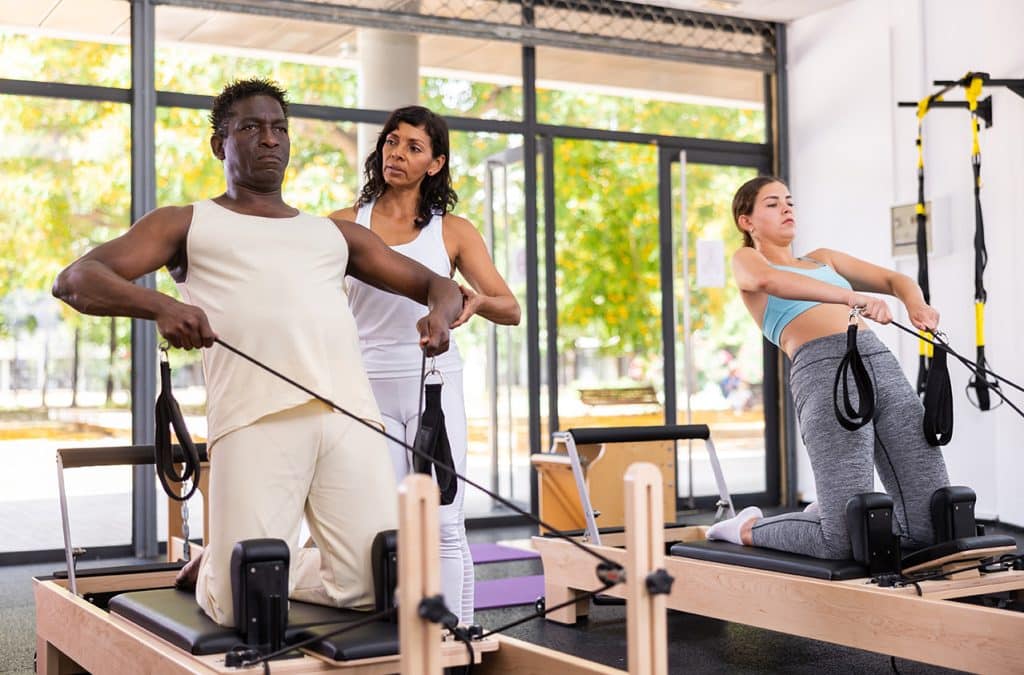
Pilates trainers are in high demand in most urban areas. I have never had trouble finding more than enough work in my 20 years as an instructor in the San Francisco Bay Area, and Orange County California. Often, I have had to turn down Pilates teaching work because I couldn’t stand to teach yet another shift!
They were chomping at the bit to hire me in Cincinnati Ohio when I was thinking of relocating to be closer to family. I sent my resume to 6 or 8 studios in the area to see what I could dig up but decided not to move after all.
Getting hire at a studio has always been fast and easy. Once you have a Pilates certification from a reputable program, some continuing education credits and a little experience, a demo class is all it takes to dazzle them into hiring you.
Teaching Pilates is nothing like taking Pilates as a student
Be forewarned!!! Being a Pilates instructor isn’t as fun as it looks!
Taking a Pilates class as a student and teaching are very different things! When you teach Pilates for a living you may find you have less time to dedicate to exercise for yourself, ironically.
You demo a movement on one side not both sides because you are not there to work out. You stand for long periods and teach the same thing hour after hour. Often studios require you to teach many beginning level classes or intro sessions. It isn’t all about you staying in shape through working out all day.
You may flinch and have to bite your tongue watching students do the same things wrong day after day even after you have given them gentle corrections one thousand times.
Often you are required to teach large groups of students who just want to sweat and don’t care about technique. Or you may have private students who are difficult to deal with so that tact is your main concern.
Sometimes getting through a single private session with a recalcitrant student can be harder than teaching the same 12-student reformer class 5 times in a row while trying project your voice and making sure no one gets injured.
Teaching a Pilates apparatus class is not like leading an aerobics class
A good Pilates instructor does not get on the equipment and teach while doing the exercises along with the students.
You may have been to aerobics classes or yoga classes or even Pilates Mat classes where the teacher does most of the exercises with the students leading the class in the movements from the front of the room without giving any individual corrections.
I have known teachers who did hop on the equipment the entire class and were fired for not teaching well. Most studios do not want the teachers who are doing the exercises along with the students.
To make a living, most Pilates teachers do 4 to 6 hours in a row 4 to 5 days per week with a combination of different class formats and/or a combination of privates, duets, and groups, So doing the exercises along with the students isn’t even feasible.
You need to be comfortable standing for long periods
A Teaching Pilates equipment classes require hours standing and walking up down the row of machines and talking loudly enough to be heard by all the students.
Most studios expect the teacher to be able to talk the students through the exercises, help with spring changes, and physical corrections, manage music and the flow of the class without doing the movements.
Perhaps if there is an empty machine you might demonstrate a new exercise while simultaneously teaching it.
A group class has to flow smoothly with easy transitions, so students feel they are getting a good workout.
Unless it is a private or intro class you do not have time to stop and explain the exercises in detail.
You must keep students moving while getting them to execute the movements properly even though you will often have mixed level classes.
Most studios demand that instructors teach groups and that the groups move the entire time and that all levels of student get a fantastic workout. This is impossible but you must smile and do your best.
Are you in love with teaching and with Pilates?
Some people are born to teach Pilates
I have known people who genuinely love teaching. Some people like being a Pilates trainer because it gets them out of the office setting away from the computer screen for a few hours a week or even full time. They love to be moving and interacting with students and are happy with teaching full-time and it is worth it to them to take a pay cut.
Some people find teaching Pilates boring and difficult
Other people find that being a Pilates trainer is not a good fit. They feel bored by the constant repetition and robotic feeling of teaching the same type of group classes hour after hour 10 to 30 hours per week. So often there is a high turnover rate at Pilates studios. Hence my ability to find a Pilates job within days just by emailing my resume to whatever studios are in my area no matter where I have lived.
Extroverts love teaching group classes
I find large groups to be draining because you are performing the whole time. You have to project your voice and keep a chirpy, upbeat, yet sonorous chatter going while watching people exercise and correcting them, so they don’t get injured. You have to have eyes in the back of your head to keep track of students on apparatus. I prefer to work one on one with clients in their home studios at a more relaxed pace.
Pilates Certification
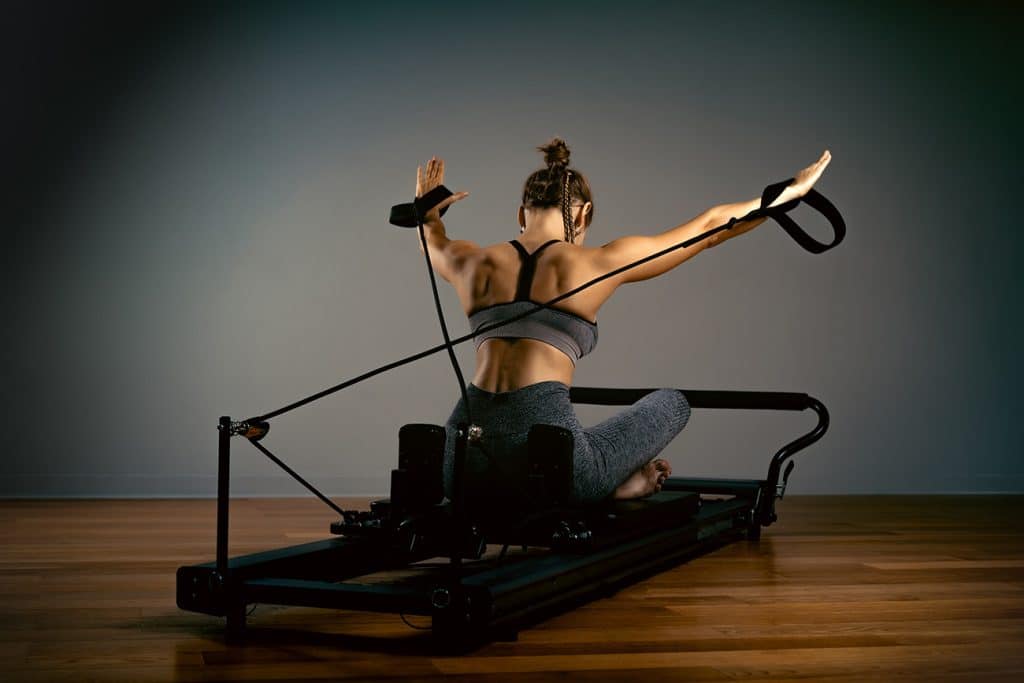
The training required to become a fully certified Pilates instructor so you can be hired to teach professionally includes learning hundreds of exercises as well as anatomy and theory.
Pilates certification can be costly, from $800 to $12000 depending upon the number of modules you take. And if done with a reputable comprehensive program, it should take anywhere from 6 months to two years to finish.
Many programs are done over many months of all-day weekend trainings on the equipment followed by months of practice teaching, hundreds of observation hours, and online coursework in anatomy, physiology, and kinesiology related subjects. Not to mention the final written exam and demonstration of your teaching.
Reputable Pilates Certification Courses
Balanced Body Pilates Certification
Balanced Body is the gold standard and one of the most widely known teacher training programs. They have in-person training in over 60 countries, and you can do one module at a time so that your money and time can be budgeted easily.
Stott Pilates Certification
Stott Pilates Certification is comparable to Balanced Body with training centers all over the world and they have specialized tracks. They allow you to do modules one at a time so you can keep your day job while you train.
Stott is the certification I did way back in 2001 for just mat and reformer and later the full comprehensive training. This is a scientifically based program with fully updated exercises to make them safe for the human body. Stott is highly respected all over the world.
Basi International
Basi Pilates offers training all over the world, gives you the flexibility to buy modules and train at your own pace, and qualifies you to take PMA Pilates Alliance exam to become a Nationally Certified Pilates Teacher in the US. I wish I had known about Basi when I did my certification because it is a little loser and more creative than Stott but still science-based movement.
There are many more Pilates certifications to choose from, but these are my top four picks because they are science-based and respected internationally.
Make sure whatever program you choose offers modern functional anatomy and physiology, and offers all the apparatus, and mat work and has a track record for students who are hired at Pilates studios.
Neu Pilates Teacher Certification
Last but not least, Nue Pilates (affiliate link) is an online program taught by a physical Therapist and a Pilates instructor. They also have a hybrid in person Program in BC Canada.
I love this program because the functional anatomy portion is so strong. On top of all the Pilates curriculum you get a detailed understanding of physical therapy principles.
This is a great program if you want to work with special populations. Also great for Pilates trainers who want continuing education.
Another nice thing about their program is they have modules that you can buy one at a time to make it more affordable.
You can try Neu Pilates for seven days and get a refund if it isn’t for you, which most other programs do not. Once you have signed up and plopped down several thousand dollars.
And they have further training teaching Pilates to special populations, like elderly, disabled and those who need rehab from injuries, once you’re certified.
This is a great option for instructors who want to gain new skills for going into a rehabilitation setting or who teach mostly private students who need extra attention due to physical limitations.
A note about Mat and Reformer Certification
Most Pilates certification programs offer mat only or mat and reformer only as well as comprehensive programs training you to teach using all the apparatus. So, you can start with just Pilates mat and reformer certification and get a job or start teaching in your own home studio and then decide if you need or want to do more.
Some people only want to teach Pilates mat-work, and you can become certified in that fairly quickly. But the pay is typically low, topping out at around forty dollars per hour because you cannot charge students very much for “just” a mat class.
People perceive the equipment as being superior to the mat-work and so instructors and studios can charge enough to make a living by becoming fully certified in all the equipment.
Financial considerations for becoming a Pilates instructor
If you need a job with health benefits, Pilates may not be the right choice for you. As a full-time income, Pilates can be frustrating because many studios do not offer benefits or pay for continuing education.
Pilates usually pays by the hour at rates from $30 to $70 per hour (in 2025) if you work for someone else. Sometimes there is an added 5 to 10 dollars per student if you fill the class at some studios. Salaried positions are rare and you can only work so many hours per week.
Pilates can pay well depending upon the company and the area. In Silicon Valley California I have made anywhere from $45 to $70 per hour teaching at Pilates studios. In less high end locations you will have to lower your expectatons.
Master Trainers make more money
One way to make more money without starting your own studio is to become a trainer of other Pilates teachers. But this requires more certifications and another outlay of money to become a master trainer, as well as lots of meetings and more continuing education.
Start a home s tudio
Starting a home studio provides more income than working for another studio without too much overhead.
If you have your own studio or go to people’s home studios, you can often charge $100 or more per visit. You still have to provide your own benefits and insurance, but you will make almost double what you can make teaching Pilates for someone else.
Studios often charge from 100 to 150 per private and give the instructor less than half of the profit as an hourly wage.
Of course, if your work from home or start your own studio you reap all the reward but you have to pay your own taxes, and do all your own advertising.
Join a Franchise or start a Pilates studio of your own
Club Pilates,Franchises can be extremely luctrative if you are in the right location or open several different studios. But this is no longer being an instructor but a whole different animal.
Teach online for larger audiences
Another way to create passive income from Pilates is with online teaching live or with pre-made courses of your own similar to what Nell Hoess has done. You can also plug into one of the many exercise platforms like BetterMe, Pilates Any Time or NewMindStart. This route requires you to be good on video and either learn to edit well or hire someone else.
Do it as a hobby or for self enrichment if you don’t need the money
Some teachers have other careers and just teach for fun on the side for a few hours per week as a social outlet. That way you don’t have to worry as much about benefits. I have known a few older Pilates teachers who are semi-retired and just like to stay busy.
As a Pilates instructor you must often supply your own health insurance, liability insurance, and pay for all your yearly continuing ed. Requirements to keep your certification current.
Corporate Pilates can be more lucrative than smaller studios
There is often a lot of turnover in Pilates studios because of the lack of benefits in small boutique studios. Though if you join a larger corporate gym that has a Pilates studio attached you can often get benefits and training.
Places like Equinox or Bay Club may offer continuing education and benefits. But at these large gyms you are expected to recruit your own students by walking around the gym, setting up free demos with gym members who are in the middle of working out and don’t really want to be interrupted.
At traditional Pilates studios they usually take care of finding students for you and all you are required to do is teach. But few of these traditional studios offer health insurance. I have worked at over 12 studios and was never offered benefits.
Most Pilates Instructors cannot sustain a full-time teaching schedule
Some Club Pilates franchise owners have enough studios to offer benefits if you work enough hours. But usually, you have to work 30 hours per week minimum to get benefits.
This might not sound like a lot of hours to work. But unlike a regular desk job you must be “on” and performing for every second of each 50-minute class you teach and learn to reset the spring settings, get a drink of water and take a pee in the 5 or ten minutes between classes.
You do not stop orating, explaining, demonstrating and watching to make sure students are safe the entire time you are “on stage”.
Pilates work in Rehab
Most Pilates instructors do not teach more than 30 hours per week unless they are in a rehab center, chiropractic office, or part of a hospital staff where you teach mostly private students. In this type of setting an instructor can relax and sit on a Swiss ball part of the time and not have to project their voice. In this setting you can get through eight hours of teaching more easily.
A rehab setting can be a lot less taxing than “performing” for the larger groups where you have to project your voice, keep the energy up, and pace up and down watching 12 students for 4 to 6 hours with a 5-minute break between each class to reset the equipment and run to the bathroom.
Large group Pilates classes give you instant cash
I have taught at small classical studios and boutique studios that have 3 to 5 reformers. I do not find this ideal because students go out of town and so your income fluctuates seasonally with many classes and private sessions canceled during vacation season and holidays.
If you’re just getting started as a teacher and you have a big studio like Club Pilates nearby that is well established, you can make steady predictable money while you build your own private clientele on the side.
Unlike small studios, there is no waiting to build up classes enough students to fill your roster. It is instant money.
I like the larger class format in that students have more access to pilates at an affordable rate. But 12 stations with reformer, chair bosu, TRX and springboard make the spacing tight. It feels like an assembly line, and it can become robotic doing almost the same thing hour after hour.
Club pilates also has some restrictions on what can be taught to the group. So, on top of a regular certification, you may need to learn the studio class formats.